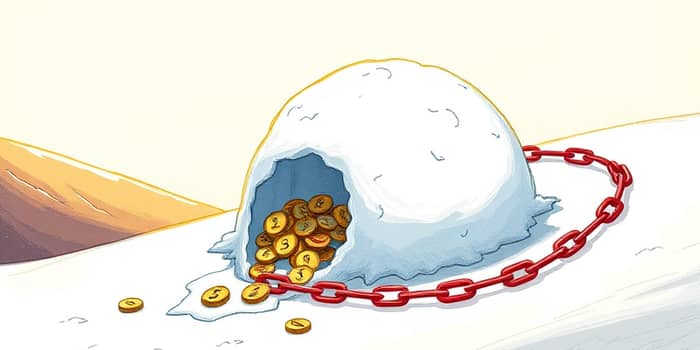
Thousands of people feel trapped by mounting debts and uncertain about the path to financial peace. What if you could transform that feeling of dread into one of confidence and forward momentum? By embracing a gradual, consistent debt reduction approach, you can steadily chip away at what you owe without feeling overwhelmed.
This article dives into proven strategies that help you dilute debt over time, harness building psychological wins and confidence, and optimize for long-term success. Read on to discover how small steps can lead to a powerful transformation of your financial life.
When facing overwhelming balances, a single aggressive push can feel daunting and lead to burnout. By choosing a more measured path, you gain the upper hand through momentum-building financial power and sustainable pacing. Gradual methods focus on small victories that reinforce your commitment, creating an emotional lift each time you clear a debt.
Moreover, a slow-and-steady plan leverages the compounding effect in reverse: instead of compounding interest against you, you compound progress in your favor. As you make consistent extra payments toward principal, interest charges shrink and more of every payment reduces what you owe.
Popularized by personal finance coaches, the Debt Snowball Method channels motivation by prioritizing your smallest balances first. Here’s how it works in four simple steps:
First, list all your obligations from the lowest balance to the highest balance, ignoring interest rates for now. Next, ensure you pay at least the minimum on every account. Then, allocate any remaining funds to the smallest debt. Finally, once that debt is paid off, transfer its minimum payment plus the previous extra amount to the next smallest debt, creating a rolling “snowball.”
For example, imagine you owe $10,000 on a low-interest personal loan, $20,000 on a credit card with a high rate, and $100,000 on a student loan. By focusing on the $10,000 loan first, you achieve a psychological win within months rather than waiting years to see progress.
Pros of this method include quick emotional boosts and sustainable, manageable progress over months. However, because high-interest accounts linger longer, you may pay more interest overall and extend your repayment timeline slightly.
For those who prioritize math over motivation, the Debt Avalanche Method shines by attacking the highest-interest debt first. The steps mirror the snowball but rank debts by their interest rates instead of balances. Maintain minimum payments across all accounts, then funnel any extra funds to the debt with the steepest rate.
This strategy can save you hundreds or even thousands of dollars in interest and often shortens the total payoff period. In one comparison, a borrower adding $300 monthly beyond minimums paid off all balances in 34 months and saved $1,341 versus the snowball’s 35 months and $9,978 in interest.
Despite these clear advantages, the Avalanche Method offers fewer early victories; the first payoff might not arrive until months into your plan. It demands interest minimization across all balances and unwavering discipline to reap its full benefits.
If neither core method fits your unique situation, consider these additional approaches. Each one adds a layer of momentum, helping you inch closer to freedom:
Selecting the right method need not be guesswork. Ask yourself which payoff style aligns with your personality and finances:
No matter which diluter you choose, success hinges on discipline and clarity. Start by building a realistic budget that prioritizes debt payments. Track your progress visually—ticking off paid debts ignites motivation and a sense of achievement.
Automate your payments to guarantee you never miss a due date. Celebrate each milestone: a small dinner out or a favorite treat can reinforce the behavior of timely payments. Remember that even on tight months, you can chip away with hope and motivation with every step.
Finally, consider a hybrid approach: use the snowball initially to build momentum, then switch to the avalanche to maximize interest savings once you feel confident. This combination delivers both emotional and mathematical wins.
Imagine two friends, Emma and Carlos, each owing $50,000 spread across three credit cards and a personal loan. Emma starts with the Snowball Method, clearing a $2,000 card in four months. Her renewed energy helps her tackle the next debt with vigor, and within 24 months she’s debt-free, albeit having paid about $3,000 in interest.
Carlos, on the other hand, uses the Avalanche Method. His first payoff comes after eight months, but by month 20 he’s also debt-free and has saved over $4,200 in interest. They each found success, choosing the path that resonated most with their mindset.
Whether you pursue rapid wins or strict efficiency, the principle remains the same: incremental progress compounds into liberation. Embrace a steady erosion of your debt and empower your financial journey with strategies designed to fit your life. The Debt Diluter approach proves that no burden is too great when tackled one step at a time.
Your journey to a debt-free future starts now. Choose your diluter, set clear milestones, and watch your financial chains dissolve into freedom from overwhelming financial burden.
References