In today’s interwoven economy, personal money management ripples across continents and industries. Viewing your cash flow as a dynamic financial ecosystem where each element influences the rest empowers you to make more informed, resilient decisions. Over the next decade, individuals and institutions alike will face shifting policies, emerging technologies, and changing consumption patterns. By aligning earnings, buffers, and spending priorities within that system, you can navigate uncertainty while working toward long-term goals.
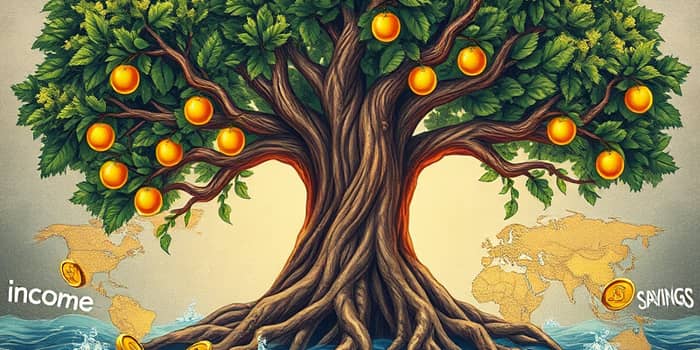
At its core, a personal financial ecosystem relies on three interdependent pillars: income, saving, and spending. These interconnected forces shaping personal wealth determine the health, growth, and resilience of your monetary life. Each pillar must be nurtured and balanced against the others to minimize risk and seize opportunities.
When you treat these pillars as parts of a single living system, you reduce stress and create synergies that deliver sustainable results.
On a macro level, financial stability supporting moderate growth is emerging as central banks balance lowering rates with managing inflation. Global GDP is projected to rise between 2.7% and 3.2% in 2026, while the U.S. real GDP is expected to grow 1.8% in 2026 and accelerate to 2.0% by 2027. India may grow by 6.7%, and China by 5% in the same period. These trends create opportunities for better debt servicing and higher savings yields.
The banking sector remains resilient, with stable asset quality and healthy capital ratios. As deposits recover and loan demand picks up, institutions are well positioned to support credit growth. Consumers benefit from this environment through improved lending conditions and higher returns on time deposits.
After peaking at 9.1% in June 2022, inflation has eased but remains a significant headwind, with prices nearly 25% higher since 2020. Central banks have signaled potential rate cuts, with the ECB aiming for 1.5% and the Bank of England for 2.75% by mid-2026. Homeowners may find opportunities to refinance, while savers can seek higher yields before rates fall further.
Yet sentiment is mixed. Approximately 32% of Americans expect their finances to worsen in 2026, while 34% anticipate improvement—the lowest optimism since 2018. With 80% expressing anxiety over money matters and 44% citing credit scores as a factor, it is clear that global trends do not always translate directly to individual confidence.
While the global backdrop sets the stage, individuals face unique headwinds. Inflation remains around 4% above pre-pandemic levels, driving 63% of people to save less in 2024. Nearly 27% of Americans had no emergency fund last year, and women held a median of $3,146 in savings compared to $7,007 for men. Young adults up to age 35 averaged $13,900 in net worth, rising to above $250,000 by ages 65–74 before declining after 75.
These figures underscore the need for actionable debt reduction and savings plans tailored to each life stage. Certain groups are particularly vulnerable:
Amid uncertainty and shifting trends, individuals can take concrete steps to restore equilibrium. Adopting emergency savings and liquidity cushions helps you withstand unexpected shocks, while intelligent spending and debt management power long-term progress. The following tactics can serve as a blueprint for most households:
The next frontier in personal finance is being shaped by technology and social innovation. Fintech platforms are expanding access to credit, allowing the mass affluent to shift up the yield curve. AI-driven productivity tools can help identify spending inefficiencies, while digital assets offer new avenues for diversification. By adapt your strategy through AI-driven insights and staying informed on regulatory shifts around stablecoins and private credit, you can position yourself ahead of the curve.
The intricate dance of earning, saving, and spending defines your personal financial journey. By treating these activities as parts of an ecosystem rather than isolated steps, you align your actions with broader economic forces and increase your chances of success. Remember, small consistent changes—automated payments, strategic debt reduction, diversified investments—compound over time into significant progress.
In the face of global volatility and personal uncertainty, you have the power to cultivate financial resilience and sustainable growth. Start today by mapping your financial ecosystem, setting clear goals, and taking one deliberate step toward balance. With perseverance, you will transform your resources into a flourishing system that supports your aspirations for years to come.
References