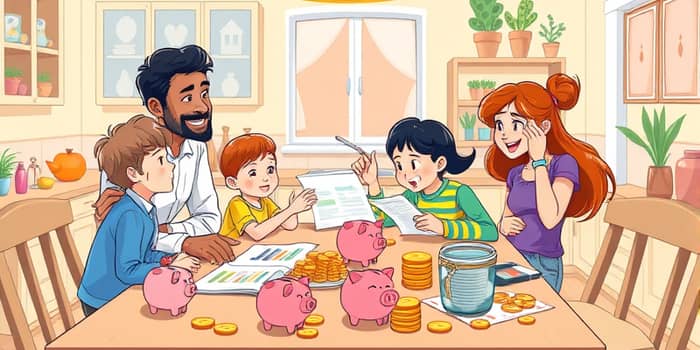
Financial literacy isn’t a luxury—it’s a necessity that shapes our daily choices and long-term dreams. Yet too many families in the United States face daunting knowledge gaps.
By uniting households around money education, we can spark intergenerational financial empowerment and transform uncertainty into confidence.
Despite living in one of the world’s wealthiest nations, Americans often struggle with basic money management. Recent data shows 65% of Americans live paycheck to paycheck, while only 44% could cover a $1,000 emergency expense from savings. Shockingly, 28% have no savings for the future, and 39% aren’t contributing to retirement funds. These gaps contribute to reliance on high-interest credit and cycles of debt.
Financial knowledge scores haven’t budged in nearly a decade. U.S. adults answer only 49% of fundamental personal finance questions correctly, with the lowest scores among Gen Z, women, and Black or Hispanic adults. When adults rate their own skills, 47% assign themselves a C or lower. The cost of low literacy is steep: roughly $1,015 lost per American annually due to mistakes, fees, and missed opportunities.
These insights reveal that family engagement creates a ripple effect: students enrolled in personal finance courses spark weekly money talks at home, and parents report improved behaviors like lower debt arrears and stronger credit standings.
Recognizing the urgency, 27 states have enacted high school graduation requirements for personal finance in the last five years. Sixteen require a stand-alone course, and another eleven allow substitutions. Where courses are offered, 77% of students complete them in states like New York and Maine, and 87% in Washington.
By 2031, an estimated 73% of high school graduates will have taken a personal finance course. Public support is overwhelming: 83% of adults nationally—and 89% in Washington—endorse mandatory financial education in schools. This growing infrastructure paves the way for families to build on the lessons learned in the classroom.
Top-ranked states link strong literacy to mandatory courses, higher education requirements, and accessible banking. In contrast, lower-ranked states often face rural access challenges and limited school mandates.
By modeling transparency and curiosity, parents can foster a safe space where questions are welcomed. This approach builds daily family money conversations that demystify complex topics and reinforce positive habits.
Start by establishing clear goals: build an emergency fund, pay down high-interest debt, or plan for college. Break these into weekly or monthly targets, and celebrate small victories to maintain momentum. Tools such as budgeting apps, simple spreadsheets, or envelope systems can streamline the process.
Consider hosting a monthly family finance night. Allocate roles—one person tracks spending, another researches investment options, a third manages saving strategies. Rotate responsibilities to give each member ownership over the household budget.
As trust grows, tackle more advanced topics like insurance, retirement planning, and tax strategies. Pair lessons with hands-on exercises: compare insurance quotes, simulate long-term saving scenarios, or explore stock market basics with paper trading accounts.
Our collective aim is to reverse current trends and empower every family with effective budgeting and saving techniques. With state mandates expanding and community support surging, the next generation stands to inherit far greater financial competence.
Schools and families must form a partnership, reinforcing lessons both in the classroom and at home. By fostering curiosity, celebrating progress, and normalizing open discussions about money, we can ensure that financial decisions become a source of opportunity rather than stress.
Ultimately, bridging the literacy gap isn’t just about numbers—it’s about freedom, stability, and the confidence to pursue dreams. When families unite around smart money choices, they weave a safety net that sustains them through life’s inevitable challenges and triumphs alike.
References