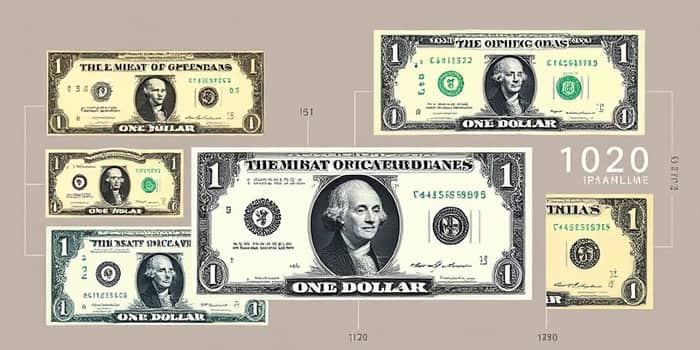
From humble colonial beginnings to today’s ubiquitous note, the US one-dollar bill embodies a saga of innovation, resilience, and trust. Over more than three centuries, it has weathered wars, economic upheavals, and technological revolutions, emerging as a symbol of national identity and enduring economic resilience and trust. In this article, we trace the dollar’s journey, exploring the design smarts, security breakthroughs, and cultural icons that give it lasting worth.
The story unfolds in four chapters: colonial experiments, wartime necessities, standardization, and modern anti-counterfeiting mastery. Each era adds a layer of ingenuity to what began as simple paper tokens and evolved into the world’s most recognized currency.
In 1690, the Massachusetts Bay Colony defied British authority by issuing the first American paper currency to fund King William’s War. These notes were a bold gamble, representing one of the earliest ventures into first decimal currency worldwide. Over the next half-century, Benjamin Franklin printed money for New Jersey, Pennsylvania, and Delaware, advocating a universal fiat system to finance colonial needs without London’s approval.
Franklin’s proposals foreshadowed modern monetary theory. His famous adage, “A penny saved is a penny earned,” underscored the power of currency management and public confidence. Yet the Continental Congress’s “Continentals,” issued in 1775, quickly depreciated into the dismissive phrase “not worth a Continental.” Hyperinflation revealed the perils of unbacked paper money and led to constitutional mandates for gold and silver coinage.
The Civil War reignited America’s hunger for flexible financing. In 1861–62, Congress authorized Treasury Notes—nicknamed greenbacks—redeemable in coin. These demand notes were the first federally sanctioned paper tender, and the inaugural $1 bill carried a portrait of Treasury Secretary Salmon P. Chase in 1862.
By 1869, George Washington replaced Chase on the front and has remained ever since. Color schemes shifted, florals and seals were added and removed, but the $1 bill’s role as a practical medium of exchange solidified during this era. The challenge of counterfeiting also came to the fore. In 1865, the Secret Service was founded to protect these notes, marking the birth of systematic anti-counterfeiting enforcement.
The small-size notes introduced in the 1920s represented a major leap in printing efficiency. Measuring a convenient 6.14 by 2.61 inches, these bills cut paper use and sped up production. With the Federal Reserve Act of 1913 looming, standard notes became essential to calm financial panics and extend the dollar’s global reach.
By 1929, every denomination adopted the compact format. The result was a unified currency system that could be recognized worldwide, backed by the United States government and safeguarded by vibrant anti-counterfeiting innovations of the modern era.
Throughout its history, the dollar’s value has pivoted between commodity backing and pure fiat. The 1900 Gold Standard Act tethered the dollar to $20.67 per ounce of gold, imposing strict discipline on money supply. In 1934, the Silver Purchase Act revised silver content from 412.5 to 384 grains, boosting federal reserves and adjusting to economic realities.
Yet by 1971, when President Nixon closed the gold window, the dollar moved fully into a modern fiat era of global trust. Each policy shift—from the Panic of 1907 to the Great Depression—embodied monetary discipline and crisis response, reinforcing the note’s role as a stable unit of exchange.
Since 1963, the one-dollar bill’s design has remained remarkably consistent, a strategic choice. Consistency aids quick human recognition—after all, the eye excels at noting subtle facial differences. As numismatist Dustin Johnston observed, “The human brain is trained at recognizing differences in facial features.”
These security measures, overseen by the Bureau of Engraving and Printing, ensure that each fresh note is both economical to produce and robust against forgery attempts. While high denominations have seen advanced color-shifting inks, the humble one-dollar bill relies on its time-tested consistency and texture.
The $1 bill transcends its monetary function to symbolize American identity. The front’s portrait of Washington connects modern transactions to revolutionary ideals, while the back’s Great Seal—complete with the eye-in-pyramid—evokes national unity and endurance.
For collectors, variations like the 1896 artistic series or the 1920s “funnybacks” add layers of fascination. Debates over eliminating the dollar coin or redesigning the note reflect broader conversations about progress and tradition. Yet the public continues to embrace the familiar green note in wallets, registers, and charitable donations.
From paper coupons of a fledgling colony to the printed tokens of a global superpower, the journey of the one-dollar bill is a testament to rich historical details and anecdotes. It reminds us that money is not merely an economic tool but a living chronicle of innovation, conflict, and culture.
As we fold a crisp new bill or discover an aged specimen, we hold more than currency; we hold centuries of American ingenuity and aspiration. The smart dollar endures because it carries within it the stories of those who minted, guarded, and used it—linking every transaction to a shared past and a collective future.
References