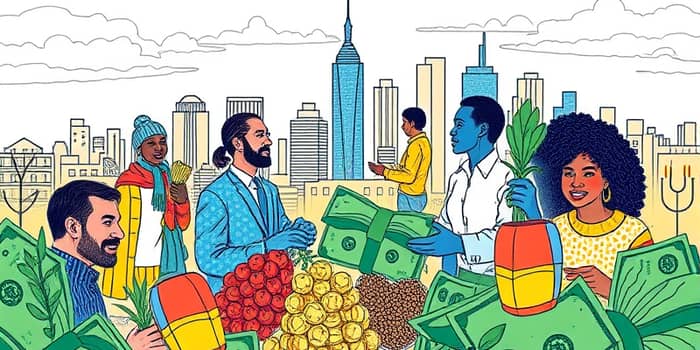
In a world defined by widening economic divides and uncertain futures, the concept of empowerment stands at the forefront of efforts to improve lives and foster resilient communities.
Economic empowerment is more than a statistic—it’s a transformative journey, granting people the ability to secure daily needs, build wealth, and shape their own destinies.
At its simplest, the empowerment line is a threshold representing the daily amount required to sustain a basic but dignified standard of living. It goes beyond international poverty measures by accounting for a range of essentials.
This includes a frugal but decent living standard with a balanced 2,100 calorie diet, safe housing in the form of a rented two-bedroom apartment in an average urban area, and minimal expenses for transportation and clothing.
Critically, it also factors in buffers for savings and social participation, which allow individuals to cope with emergencies, engage in cultural activities, and save for future investments or education.
Unlike traditional poverty lines that focus solely on survival, the empowerment line captures the resources needed for upward mobility and wealth-building over time.
Despite remarkable progress in reducing extreme poverty—over one billion people have emerged from its grips in the last thirty years—empowerment remains out of reach for a majority of the planet. As of 2020, roughly 60–61% of the world’s population, or 4.7 billion individuals, fell below this threshold.
These disparities are not uniform: low-income countries (under $5,000 GDP per capita) see only 20% of their populations empowered, while upper-middle-income nations ($5,000–$20,000 GDP per capita) hover around 50%, and high-income economies exceed 80% in many cases.
However, the cost of living can erode these gains. For instance, in high-income regions where housing or healthcare costs surge faster than wages, significant pockets of the population may struggle despite robust average incomes.
Concentrated efforts in fast-growing economies—most notably China and India—have driven large-scale reductions in extreme poverty but highlight the distinction between survival and true economic empowerment.
Understanding why some populations achieve empowerment while others lag involves unpacking the interplay between income, cost structures, and inequality. In low-income countries, GDP per capita alone explains 79% of empowerment variance, but this falls to 14% in high-income nations.
When affordability and inequality factors are added, explanatory power jumps to 85% in low-income settings and up to 95% in wealthier contexts—underscoring the need to address prices as well as earnings.
Economic growth that merely raises average incomes without containing price levels can leave many at the bottom 20% stranded, unable to translate higher wages into better living standards, a situation reflected in mounting rent and healthcare costs across developed markets.
Housing and food represent over 60% of the cost difference between best and worst performing peers, highlighting the critical nature of reducing essential cost burdens.
No single approach can unlock economic empowerment across diverse contexts. Governments must drive macroeconomic policies that foster sustainable growth while countering structural barriers that keep costs of living high.
At the same time, the private sector can catalyze change by innovating affordable housing models, scaling essential services, and deploying data-driven tools to measure impact against empowerment benchmarks.
Community organizations and civil society play a vital role in tailoring programs to local needs, building trust, and ensuring that interventions resonate with cultural norms and social dynamics.
Investing in women’s economic empowerment yields outsized returns, driving faster growth, improved health outcomes, and more resilient societies. Evidence shows that women’s labor force participation boosts GDP and directs household resources toward essential needs.
Efforts to promote female entrepreneurship are particularly impactful when they combine legal reforms, access to finance, and supportive services. For example, Kyrgyzstan’s 2025 law recognizing women’s entrepreneurship has enabled targeted credit schemes and data collection, while “Government Accelerators” that reduce childcare barriers have seen 90% women entrepreneurs flourish.
By integrating gender-focused metrics into program design and evaluation, stakeholders can ensure initiatives produce measurable improvements in both income levels and broader empowerment indicators.
Economic empowerment is the bridge between survival and thriving, encompassing not just the ability to meet immediate needs but also the freedom to pursue aspirations and build legacies. It is the foundation of stable families, innovative businesses, and prosperous nations.
Realizing this vision demands coordinated action—policy reform to curb essential expenses, private investment in scalable solutions, and inclusive programs that put people at the center. With data-driven insights guiding each step, the global community can turn the empowerment line from a measure of disparity into a roadmap for opportunity and shared prosperity.
References