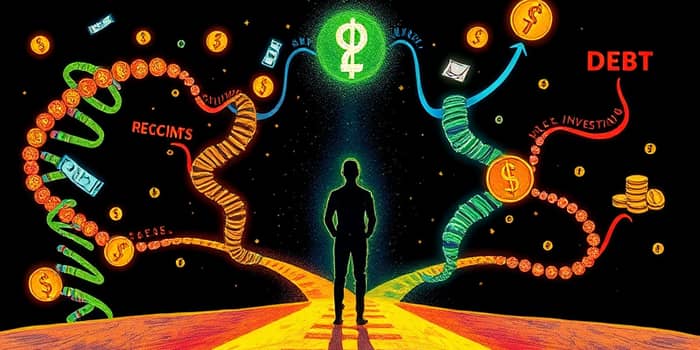
Financial well-being depends not only on income or market returns but on the unique set of habits, emotions and choices that make up your personal “Spending DNA.” By unlocking the hidden drivers behind spending, saving and investing, you can chart a course toward true security and growth.
This journey blends data-driven insights with actionable techniques, offering a path to break free from cycles of impulsive splurges or paralyzing inertia.
By examining your spending history, you uncover the patterns that shape every financial decision. These patterns often originate in childhood experiences, social influences, and deeply held beliefs about self-worth and success.
Researchers from Deloitte (2025) reveal that global financial well-being rose modestly in recent years, yet individual disparities persist. Understanding your personal pattern helps you move from statistical averages to meaningful change in your own life.
Every decision, from whether to build an emergency fund to how much you allocate to discretionary purchases, reflects underlying patterns that form your financial blueprint. Psychologists and financial experts call these patterns ingrained emotional spending habits and note that they often manifest as biases or recurring behaviors.
Consider how a default gym membership, once forgotten, can drain hundreds of dollars annually. This is inertia in action—a subtle force that keeps you on a path long after it ceases to serve you. Similarly, an outdated budget or neglected retirement plan can remain unchanged unless you consciously intervene.
For example, research shows that nearly half of Americans battle financial imposter syndrome. Despite stable incomes and prudent choices, they feel undeserving or unqualified to manage their own wealth. Others struggle with present-bias, prioritizing immediate gratification over long-term gains, or status quo bias and inertia, letting default setups dictate the flow of their money.
Financial literacy plays a role in shaping outcomes, but its measurable effect on behaviors is modest—explaining roughly 0.1% of variability in healthy vs. unhealthy money decisions. This underscores the fact that emotional and psychological drivers frequently outweigh knowledge alone.
Behaviors vary widely across income, education and life stage. A study of over 3,000 consumers revealed that higher earners engage more in investing but often carry greater debt. Meanwhile, high school graduates adhere to budgets at a remarkable rate of 67%, outperforming those with advanced degrees.
Education influences behavior in surprising ways. Studies show that high school graduates, though often lacking advanced knowledge, adopt emergency funds and budgets more consistently than college-educated peers. This suggests that discipline and habit formation can outweigh technical expertise when building foundational security.
Race and ethnicity also shape outcomes, as systemic inequalities limit access to high-quality financial guidance and capital. Targeted interventions in underserved communities can help close these gaps by addressing both literacy and emotional support needs.
Emerging adults present another critical pattern: roughly 32% are financially precarious, 36% at risk. Only 22% achieve stability, highlighting a need for tailored support during early career phases.
Stress, confidence and risk aversion profoundly shape financial choices. Chronic stress can trigger impulsive purchases as a coping mechanism, while low confidence discourages potentially lucrative investments. Even those with high financial knowledge can be derailed by subtle biases.
In one experiment, rearranging a school cafeteria increased fruit consumption by over 25%, showcasing how present-bias and status quo bias can be harnessed for good. Imagine applying similar design principles to your wallet: placing your savings app icon prominently on your phone home screen or setting default “round-up” options in your checking account.
Financial imposter syndrome deserves special attention. It manifests as persistent doubt, even among high earners. You might shrug off compliments about your investment acumen or reject advice to allocate funds toward higher-return portfolios. Recognizing this voice of doubt is the first step to quieting it.
By pinpointing these triggers, you gain the power to intervene on behalf of your future self rather than reacting in the moment.
Transforming entrenched patterns begins with awareness and small, structured changes. Consider Mr. Sad and Mr. Happy, two archetypes illustrating the impact of intentional strategies:
Mr. Sad frequently succumbs to impulse purchases when stressed, lacks an emergency fund and hesitates to invest. Mr. Happy, on the other hand, uses a budgeting app, automates transfers to savings and reviews investments monthly. The difference lies not in income, but in disciplined behaviors and supportive systems.
Self-assessment tools like cash flow trackers can shine a light on invisible leaks—subscription services you no longer use or recurring fees that slip under the radar. Commit to a monthly audit, flagging any charge that doesn’t align with your values or goals.
Building an emergency fund is both practical and psychological. Research by Vanguard indicates that having at least three months of reserves can boost overall well-being by emergency savings boost financial well-being. This buffer transforms money from a source of stress into a tool for resilience.
Such steps gradually rewire impulsive habits into consistent, growth-oriented routines.
Fintech solutions and behavioral design offer powerful levers to reinforce positive choices. Budgeting apps can provide real-time alerts when spending thresholds are met, while retirement plans with auto-enrollment exploit status quo bias to boost savings rates.
Fintech innovations continue to democratize access to sophisticated strategies once reserved for institutional investors. Algorithms can now automatically balance your portfolio, rebalance assets, and reinvest dividends, all while you sleep. Integrating these capabilities into everyday behavior can tip the odds in your favor.
Policymakers and employers can also play a role by embedding negative consent features in retirement plans, trialing behavioral interventions that respect individual autonomy while steering collective progress. The results speak for themselves: auto-enrollment and default contribution escalations have increased participation rates dramatically.
By embedding tailored financial education programs into these platforms, you address both knowledge gaps and emotional drivers. Nudges need not be heavy-handed. Opting for a default savings increase of 1% annually or using reminders to log daily expenses can yield significant long-term benefits without restricting choice.
As you implement these practices, remember that setbacks are part of the process. Market downturns, unexpected expenses or emotional relapses may challenge your resolve. Use them as opportunities to learn more about your personal patterns and refine your strategies.
Envision a future where your money moves in harmony with your dreams. Each dollar saved, invested or allocated toward debt repayment resonates as a vote of confidence in your potential. Over time, these votes accumulate, forming the legacy of financial security you leave for yourself and future generations.
By decoding and realigning your Spending DNA, you claim authorship over your financial story. This is not a one-time project but a lifelong practice of mindfulness, adaptation and growth.
References